05 September, 2010

Unique opportunity for T&T


The M1 is described as “rugged, reliable, accurate, and durable.”

The US government has forbidden the sale of 850,000 rifles to the US.

“The South Korean government, in an effort to raise money for its military, wants to sell nearly a million antique M1 rifles that were used by U.S. soldiers in the Korean War to gun collectors in America.”

This is a unique opportunity to increase national and private gun ownership at a very affordable price. These rifles usually retail for about US$400-500 each. At that quantity, the TTDF could conceivably bag them at US$200 each, or even less. That would be just over TT$1B. Less than the cost of 2 summits, with more immediate and tangible return on investment.

Most air rifles in Trinidad sell for 6x more (at the lower end of the market!).

The government can easily recover that money by reselling some to other Caribbean governments, with some set aside for sale to T&T citizens.

Even though they aren’t considered “sexy”, they are functional rifles that have proven their utility during the Korean War, and over time. The M1 is described as “rugged, reliable, accurate, and durable.”

The TT Cadet Force, TT Defence Force Reserves and others are all short of rifles. This is an excellent, inexpensive training rifle and a battle-proven tool.

With the right planning and contract negotiation, we could manufacture our own ammunition, as the M1 has an uncommon caliber (.30). A new industry can be born. New armourers and gunsmiths can be trained. The same Caribbean governments that buy the rifles can be tied in by contract to buy our ammo too.


If the government doesn’t want too much risk, then we can partner with other Caribbean nations through CARICOM and share the risk.

With more armed citizens, we should see a dramatic decrease in murders and other violent crimes. The Minister of Food Production has said he is looking at re-starting the praedial larceny squad. The squad cannot be everywhere, and therefore cannot protect all farmland. Armed farmers can dispatch vermin attacking their crops and livestock, and also protect themselves, their families and employees from violent criminals. Arming farmers can improve food security for the nation.

A word to the anti-gunners: Please, no knee-jerk reactions. No tired platitudes of these rifles “falling in to the wrong hands”. The “wrong hands” are already filled with all the guns and ammo they need. It’s the “right hands” that are empty and defenceless.

This is one time we can ask Israel for technical assistance in creating a new industry and arming citizens, as they have expertise in that area. Be prepared for them to turn us down though, as selling arms and ammunition is one of their biggest industries. We can also ask Venezuela, the US, or Brazil for technical assistance.

Some legislation may have to be enacted, but with a three-fifths majority in Parliament, the government should not have any problems in this area.

This should be seen for what it is: an opportunity for our nation to improve national security, increase employment, create a new industry, re-skill our citizens and increase national food security.

“An armed society is a polite society.” -Robert A. Heinlein.

31 August, 2010

Happy Independence T and T

Today, our country is 48 years old. Happy Independence to all.

13 August, 2010

Venezuela and Colombia achieve détente


On the brink of war a few short weeks ago, Venezuela and Colombia have managed a loosening of tensions. Both countries presidents met and signed agreements in Santa Marta, Colombia recently. A re-establishment of diplomatic relations was pre-eminent.

The newly elected Colombian President Juan Manuel Santos and his Venezuelan counterpart President Hugo Chavez agreed to set up five committees to address debt, border, security, joint projects and joint infrastructure.

Just a few weeks ago, the word ‘war’ was used in cross-border fiery rhetorical exchanges between President Chavez and (then) Colombian President Alvaro Uribe.

Trinidad and Tobago should follow these events very closely as the relationship between the two South American countries impact us because of geography, economy, military and social issues.

If minor flooding has us pushing out (firing) the ODPM’s CEO and apportioning blame, then an influx of Colombians and Venezuelans (maybe even US, British and Canadians fleeing to safety) will overwhelm us and our resources.

Then there is the issue of TT/Venezuela hydrocarbon agreements.

06 July, 2010

New Police Commissioner


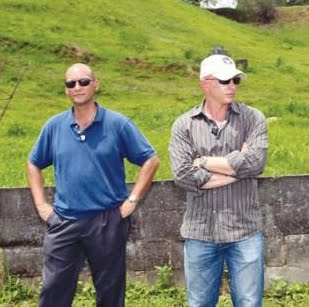
Police Commissioner-designate, Canadian Dwayne Douglas Gibbs.


Trinidad and Tobago has a new Police Commissioner-designate. He is Canadian Dwayne Douglas Gibbs, a retired Superintendent of Police of the Edmonton Police Service in Alberta, Canada. Gibbs’ appointment was approved by Parliament last Friday.

Another Canadian, Jack Ewatski will be appointed Deputy Commissioner of Police. Ewatski is a retired Chief of Police at the Winnipeg Police Service.

Could this be the break that airgunners are seeking? Will this new Police Commissioner bring a fresh set of eyes and -- more importantly – ears to the office? Will we be able to shoot larger bore, and rifled airguns before the end of his contract?


Would FULs be renewable every five years, as in Canada, instead of the annual ritual that it is presently? Would the FUL application refusal rate be reduced from the present 95% to the 0.15% as in Canada?

01 July, 2010

Rifle Racks


You can make your own simple rifle racks. Here’s a link with specs:

http://7.62x54r.net/MosinID/MosinRacks.htm


For those who can afford it, PriceSmart has a decent 5ft gun safe for about $5,000.

26 June, 2010

Venezuela’s militia


Venezuelan citizens train to defend their nation.

Venezuela is the South American country most likely to survive and repel an invading force. The simple reason for this is the civilian militia.

According to Global Firepower, Venezuela has an active troop strength of 800,000. President Chavez has boasted of a civilian militia numbering about one million. Some estimate the number may be closer to 100,000-200,000.

A modern conventional force from the USA or Brazil can easily overrun Venezuela. However, because of terrain, cultural, political and other factors, the invading force will have an even harder time than in Iraq.

With Venezuelan political leadership sharing ideology with neighbouring Bolivia and Ecuador, the Venezuelans will receive help from these countries with additional support from guerilla movements like FARC, and others.

As Vietnam, Iraq and Afghanistan has shown us, motivated civilian populations (through militia using guerilla tactics and asymmetrical warfare strategy) can harass, ambush, sabotage, detain and kill invading troops on a regular basis. This is quite effective in the Psy Ops area, serving to demoralize the invaders and forcing them to question their reasons for being in the country.

Because of our (self-inflated?) strategic importance to the USA, Trinidad and Tobago has never envisaged nor planned for an invasion by a foreign force. Our national defence planners assume that the US will defend us because of our oil and gas supplies. What happens when the gas and oil runs out?

With an active troop strength of 3,000 and a reserve of 500, miniscule Trinidad and Tobago would be easily occupied. What’s worse, an unbroken policy (since colonialism) of keeping a population disarmed has created a hoplophobic culture. Illegal guns proliferate among unemployed, ill-disciplined youth. Perhaps MILAT and MIPART can be the seeds from which our militia springs, as the fear of guns may be too deeply ingrained in the psyches of the older citizenry.

Even the world’s sole superpower considers a militia so vital to a nation’s survival that the 2nd amendment of the US constitution specifically grants the rights of gun ownership to all citizens, and mentions the militia in the same amendment.

Shouldn’t we be just as concerned about our nation’s survival?

27 May, 2010

Untapped human resources


Yesterday I went to a friend’s house to pick mangoes. I got into a conversation with my friend’s neighbour and discovered he is a retired police armourer. He spends his days tending a small kitchen garden and reminiscing with any other retired law enforcement or military personnel about “the good old days”.

This man has a wealth of practical know-how and real life experience. He is a classic example of an abundance of skilled retirees who are allowed to waste their golden years without passing on their expensively-acquired skills. Instead we hire the most expensive foreign ‘experts’ and complain about the economy. Yet we ignore the plethora of skill sets available, just for the asking.

A number of senior citizens would happily share their skills, knowledge and wisdom, if we only ask. The Japanese have recognized the value of their senior citizens and are harnessing this power, passing it onto the youth. The interaction helps both generations, as the seniors get to mingle with youth and feel valued. The youth get much needed skills, knowledge, the benefit of avoiding pitfalls, while understanding that “foreign” doesn’t necessarily mean “good”.

I submit that should we ask nicely, and he agrees, this single retired armourer can teach scores -- or maybe hundreds – of young people to maintain and repair small arms and weapons systems for our various agencies that require them. Some can become civilian gunsmiths, including airgunsmiths. Some can be inserted into any civil defence programmes. And boy do we need those skills!

With national security units such as SUATT, SSA, the TT Police Service, TT Regiment, TT Coast Guard, TT Air Guard et al, those skills are currently in short supply and high demand. The Forensic Science Centre also assists the Police Armourer, sometimes because of the enormous workload.

The incoming National Security Minister can tap this most valuable of resources. Just remember to ask nicely.

26 May, 2010

First woman Prime Minister

 
Congratulations to the People’s Partnership, a coalition of the United National Congress (UNC), the Congress of the People (COP), the Tobago O People (TOP) and the National Joint Action Committee (NJAC). Congratulations also to the 12 Peoples National Movement (PNM) newly elected Members of Parliament.

The final result: Peoples Partnership 29, Peoples National Movement 12. With a near two-thirds majority, the government-in-waiting will have little trouble passing important legislation. Now may be a good time to deal with the archaic firearms laws. So, along with “a chicken in every pot”, perhaps “a gun in every home”? Come on MPs, don’t squander this golden opportunity.

Trinidad and Tobago is about to get our first woman Prime Minister. Congrats Kamla! She was also the first female Attorney General, the first female Minister of Legal Affairs, the first female political leader of a major political party and the first female Leader of the Opposition. A number of ‘firsts’.

She has signaled a willingness to listen to the needs of the populace, by suggesting referenda for major thorny national issues and decisions. Let’s hope she is also the first Prime Minister to keep her word, on all promises and pledges. Mrs Persad-Bissessar will be sworn in this afternoon. One wonders about the curious situation of the foreign bodyguards, though.

Trinidad and Tobago is now in a state of euphoria, in direct contrast to the situation in Jamaica. The limited state of emergency declared by the Jamaican government in two parishes has brought daily life in the capital city of Kingston to a virtual halt. This situation needs immediate resolution. It shows what can happen when senior politicians make deals with criminal leaders.

16 April, 2010

General elections 24 May


It’s official: Prime Minister Patrick Manning has named the date of the next general elections, May 24th, 2010. It would be fantastic to see the three political leaders (Dookeran, Persad-Bissessar and Manning) debate the issues live, like British politicians did this week.

If wishes were horses…
 
free counters